Aligning offshore wind deployment with local priorities to accelerate power system decarbonization
Communications Earth & Environment
Aligning offshore wind deployment with local priorities to accelerate power system decarbonization
Peng, Liqun, Gang He, Nikit Abhyankar, Haozhe Yang, Umed Paliwal, and Jiang Lin*
Communications Earth & Environment (2026)
DOI: 10.1038/s43247-026-03533-9
Abstract
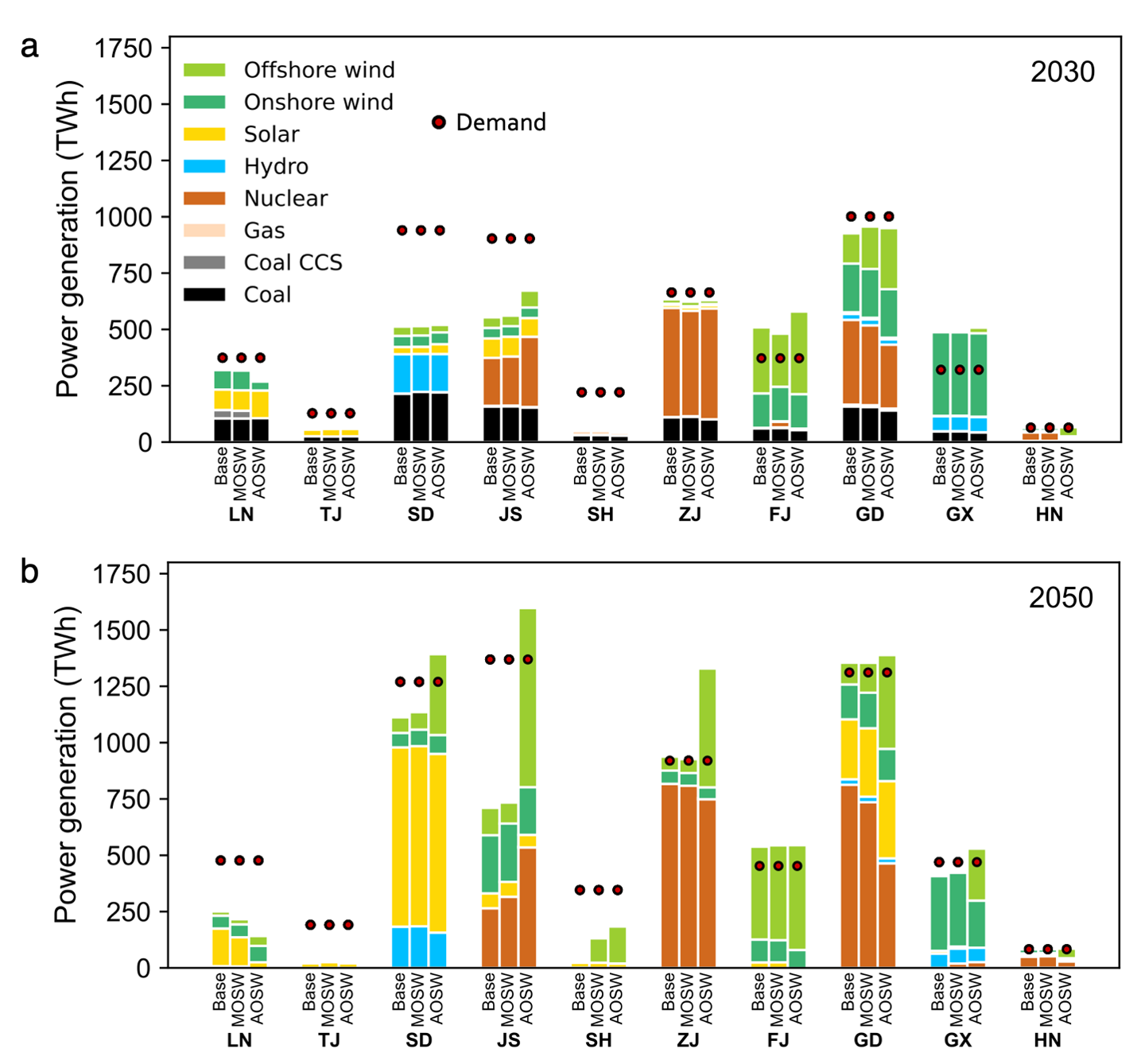
Accelerating offshore wind power deployment, a critical but underutilized resource for decarbonizing power systems, requires balancing national and local interests. Using China, the global leader in offshore wind, as a case study, here we evaluate how its deployment creates benefits, such as improved energy self-sufficiency, greater resource diversity, enhanced grid reliability, and increased local investment and employment. Our results show that offshore wind can bolster the energy self-sufficiency of coastal provinces, shifting them from net electricity importers to exporters. Furthermore, expanding offshore wind reduces the need for energy storage in a grid with high renewable penetration and drives substantial local investment and job creation. After quantifying uncertainties in policies, technology costs, and electricity demand, we find offshore wind could provide 3–18% of China’s electricity by 2050. Aligning local interests with offshore wind development can facilitate more ambitious targets and accelerate power system decarbonization with limited increases in system costs.
Links
Published paper
Open-access pdf
Citation
@article{peng2026,
  author = {Peng, Liqun and He, Gang and Abhyankar, Nikit and Yang,
    Haozhe and Paliwal, Umed and Lin, Jiang},
  title = {Aligning Offshore Wind Deployment with Local Priorities to
    Accelerate Power System Decarbonization},
  journal = {Communications Earth \& Environment},
  volume = {7},
  pages = {533},
  date = {2026-04-21},
  url = {https://www.nature.com/articles/s43247-026-03533-9},
  doi = {10.1038/s43247-026-03533-9},
  langid = {en}
}